
Children’s Mental Health During the COVID-19 Pandemic: Parents' Biggest Concerns About Their Kid's Mental Health by Ann & Robert H. Lurie Children's Hospital of Chicago
Note: 30Seconds is a participant in affiliate advertising programs and this post may contain affiliate links, which means we may earn a commission or fees if you make a purchase via those links.
Among the most talked-about consequences of the COVID-19 pandemic is the toll taken on mental health, both in children and adults. Mental health experts were concerned about repercussions from the very beginning, but inevitably, given the stakes of contending with the virus and the unfamiliar territory we’ve all found ourselves in, it has been difficult to manage proactively.
Now a year into the pandemic, hopefully with the worst of its acute consequences behind us, we’re eager to understand parents’ experiences monitoring and managing their children’s mental health. Recently, we polled 1,000 parents across the U.S., focusing our inquiry on how parents contextualize the impact of the pandemic on mental health, what choices they regret making and what they’ve done to constructively address challenges. For parents who live with multiple children, we asked them to focus their responses on the child they are most concerned about with respect to mental health.
We began by asking parents to describe their general feelings about the pandemic’s effects on mental health. Not surprisingly, a majority of parents are distressed by the situation. Seventy-one percent believe the pandemic has taken a toll on their child’s mental health, 69 percent say the pandemic is the worst thing to happen to their child and 67 percent wish they’d been more vigilant about their child’s mental health from the beginning.

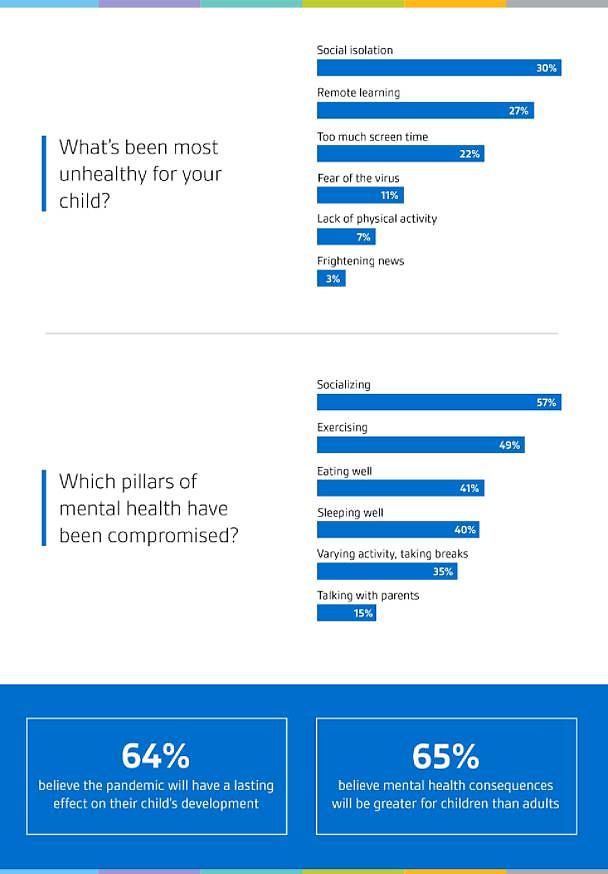
Parents cited social isolation as the most unhealthy aspect of the pandemic, followed by remote learning and too much screen time. Notably, all three of these factors were cited at least twice as frequently as fear of the virus.
“From the perspective of stressors, this is good news,” says Colleen Cicchetti, PhD, Executive Director, Center for Childhood Resilience and Clinical Psychologist, The Pritzker Department of Psychiatry and Behavioral Health. “Children being impacted by the more serious effects of the virus, including loss of loved ones and the anxiety of instability of parental income, food insecurity and homelessness are more toxic stressors. Children experiencing toxic levels of stress or trauma are more likely to have longer-term impact from their COVID experience and require more specialized care and interventions. The factors that most parents from this sample identified represent factors that, while significant, are also beginning to shift as the COVID-19 restrictions are lifted.”
Thinking about some of the pillars of mental health – socializing, exercising, eating well, sleeping well, varying activities, processing experiences – it’s clear a range of things were compromised all at once. And many parents believe they’re facing a problem that will have long-term consequences. Sixty-four percent believe the pandemic will have a lasting effect on their child’s development, with most (71 percent) citing emotional development as their top concern.
There are some positive outcomes to celebrate, with respect to parenting. Of the parents we polled, 87 percent said they are spending more quality time with their children and 78 percent said they are showing more affection to their children than before the pandemic.
Along with that increased affection came a softening of rules, for better or worse. Seventy-three percent of parents said they relaxed certain rules during the pandemic. Of that group, 70 percent cited screen time, 56 percent cited bed and wake times, and 51 percent cited food-related rules. In reflecting on rules, a common sentiment among parents (68 percent) is that they wish they’d let their children socialize more, believing some of the protective benefits did not outweigh mental health consequences.
“From the perspective of mental health professionals, parents being better attuned to their child’s social and emotional needs is another potential silver lining to this pandemic,” says Dr. Cicchetti. “While parents may be second guessing some of the decisions that they made during this uncertain time, it is clear from this sample that many parents have been actively trying to adjust routines as needed to manage the disruptions to family, school and social norms.”

Parents most frequently cited “talking and comforting” as the primary way they work to bolster their child's mental health. Additionally, 56 percent helped their child pursue hobbies and fun activities and 42 percent encouraged better sleep. One particularly encouraging development: 37 percent of parents said they encouraged some practice of mindfulness and relaxation as a coping tactic, and 55 percent say their child has at some point tried mindfulness techniques to manage stress, irrespective of the pandemic.“
This response underscores that we have seen an increase in willingness to consider and actively address stress and mental health from parents, teachers and health care professionals,” says Dr. Cicchetti. “This reduction in stigma of mental health has the potential to change the emotional toll on children both as we return to more typical routines and over the long term. In particular, educators are proactively seeking out tools and strategies for promoting social-emotional functioning and skills universally; health professionals are offering more screening and parent coaching on how to support coping skills at different ages; and apps for managing stress, connecting to loved ones and learning more about mental health are just a click away.”

One of the most important missions at Lurie Children’s is to ensure broad access to care throughout communities, and to educate the public about the existence and efficacy of such care. Of the parents we polled, 58 percent said their child would benefit from professional help with mental health challenges. From that group, 42 percent have been successful seeking help, 36 percent tried but could not get help, and 22 percent did not formally try. Overall, 41 percent of respondents said they don’t know where to get help for their child’s mental health.
“These challenges are the reason that our professionals from the Center for Childhood Resilience (CCR) are focused on the mission of increasing access to adults who can support the mental health and wellness of all kids where they live, learn and play,” says Dr. Cicchetti. “Equipping adults with these tools will shift the focus of community resources to prevention and promotion, through training for teachers, health professionals and other youth serving leaders (scout leaders, coaches and faith leaders). Through training parents and community leaders, we can also identify children needing additional resources earlier and link them to services through their schools and communities. Our current mental health system only meets the mental health needs of about 25% of children who need them. Our goal is to build a public health approach to children’s mental health that will be able to meet the need during typical times, and to address the increased needs that develop during community crises including pandemics and natural disasters.”
Methodology: Between March 19 and April 2, 2021, we polled 1,000 Americans with at least one child living at home between the ages of 2 and 24. Respondents were 54 percent female, 46 percent male, and ranged in age from 21 to 64, with an average age of 37. For parents of multiple children, we asked them to answer questions in consideration of the single child whose mental health they are most concerned about.
The content on 30Seconds.com is for informational and entertainment purposes only, and should not be considered medical advice. The information on this site should not be used to diagnose or treat a health problem or disease, and is not a substitute for professional care. Always consult your personal healthcare provider. The opinions or views expressed on 30Seconds.com do not necessarily represent those of 30Seconds or any of its employees, corporate partners or affiliates.
Take 30 seconds and join the 30Seconds community. Inspire and be inspired.
30Second Mobile, Inc. is a participant in the Amazon Services LLC Associates Program, an affiliate advertising program designed to provide a means for us to earn fees by linking to Amazon.com and affiliated sites.
Related Products on Amazon We Think You May Like:


join discussion